ETHNOBIOLOGICAL ABSTRACTS
Comparative Biochemistry and Antibacterial Activity of Medicinally
Use Honey Produced by Apis mellifera S. and Melliponid Species of
Northern Amazonas State, Venezuela
DeMera, J.H.1, A. García2, J. M.
González3, F.I. Michelangeli2, and E.
Rodriguez1
(1Cornell University,
2IVIC,
3Fundación Terramar;
Research conducted at the Yutajé research station and IVIC, Venezuela
1997)
The keeping of bees by different cultures for purposes of harvesting honey
and wax has a long standing tradition and history. Beekeepers and honey
enthusiasts alike have long touted the medicinal qualities of honey. While
the chemistry of honey is well known, few studies have been undertaken in
order to discern which compounds are behind the purported medicinal qualities
that honey might exhibit. Traditionally, the native cultures of the Amazon
have harvested both honey and wax from species of stingless bees (Meliponinae)
found in the wild. Natural hives were either sought out or hives intentionally
created in hollow logs. The Piaroa, an indigenous group from Amazonas State
in southern Venezuela, recognize at least seven different folk taxons of
stingless bees from which honey is harvested for food and medicine. While
the Piaroa recognize the alimentary value of honey produced by Apis mellifera
S. and administer honey to their children as a general protection from disease
and infection, they value the honey less than that produced by the meliponid
species for its specific medicinal qualities. Objectives of the study presented
were to discern the bioactivity and secondary chemistry differences/similarities
between honey produced by the Africanized honeybee (A. mellifera S.)
and honey produced by certain stingless bees (Meliponinae). Meliponid honey
(100%) inhibited the growth of Serratia mar. and Shigella
flexneri. Meanwhile, honey (100%) from Africanized honeybees (San Juan
de Manapiare) inhibited the growth of Pseudomonas auruginosa.
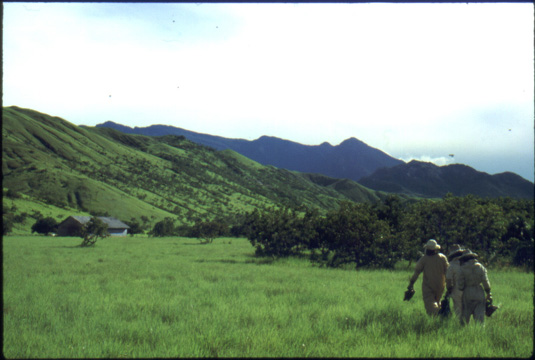
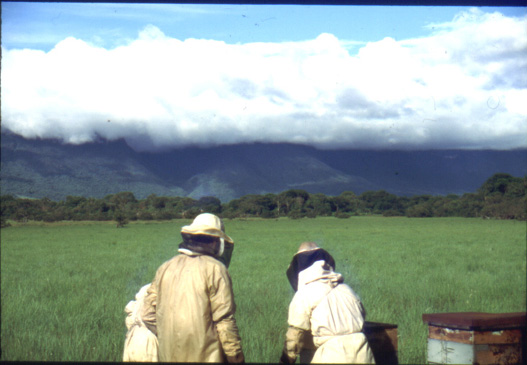
Researchers and members of the Piaroa community at Guanai work to restore
bee hives to increase their honey yield (above and below).
Photos by Jason DeMera '98
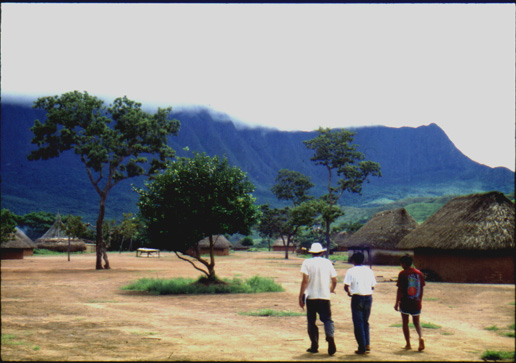
The Piaroa village at Guanai, one of three research sites in this study.
Photo by Jason DeMera
A Study of Piaroa Ethnopharmacognosy
Luckeroth, P.D.1, Safi Darden1, F.I.
Michelangeli2, E. Rodriguez1, and S.
Zent2
(1Cornell University,
2IVIC; Research conducted
at the Yutajé research station and IVIC, Venezuela 1996)
The tropical rainforests are seen as a key component for the discovery and
development of new drugs because of its great biodiversity and ecological
complexity. In an environment like this, it is nearly an impossible task
to screen all plants species because of time, geographic, and economic
constraints. Therefore, this study adopted the approach of studying how the
Piaroa use the forest's resources to treat illnesses. In our study, we
interviewed a Piaroa herbalist. Two sets of extractions were done for the
plants studied, one of fresh plant material in ethanol and the other was
made according to the methods of preparation indicated by our Piaroa
collaborator, Basilio Moreno. Both sets of extractions were compared in order
to determine if the method of preparation of these plants had any affects
in their chemical and medicinal properties. The different extracts were compared
using TLC analysis and tested for anti-bacterial activity. The bacteria tested
were: Staphylococcus aureus, Serratia sp., Shigella
flexneri, Escherichia coli, Pseudomonas aeruginosa, and
Salmonella sp. The results from the bioassays indicated that both
sets of extracts for a given plant exerted similar effects on the bacterial
growth.
Ethnobotany of Campsiandra sp.
Luckeroth, P.D.1, F.I. Michelangeli2, E.
Rodriguez1, and S. Zent2
(1Cornell University,
2IVIC; Research conducted
at the Yutajé research station and IVIC, Venezuela 1997)
The genus Campsiandra Benth.(Caesalpinaceae) consists mainly of riverine
trees that are distributed throughout the rivers and streams of the Amazon
basin of Brasil, Orinoco basin of Venezuela and Esquibo-Carantijin basin
of Guyana and Surinam (Stergios, 1996). Plants in this genus have been reported
to have medicinal and nutritional value among different indigenous groups
of South America. The objectives of this study were to record ethnobotanical
data on the uses that the Piaroa and the Guahibo Indians give to the species
of Campsiandra present in the Manapiare Valley and to determine the
bioactivity of species against different bacterial strains. Both Piaroa and
Guahibo Indians use the bark to treat diarrhea. In addition, the Guahibos
utilize the seeds of Campsiandra for nutritional purposes. Extracts
were prepared from the plant parts used medicinally and nutritionally, and
bioassays were conducted to test for bioactivity against different pathogens
such as Shigella flexneri, Staphylococcus aureus, Serratia
marcescens, Pseudomonas aeruginosa and Escheircha coli.
Meanwhile, the extracts of C. comosa did not affect Escherichia
coli and Serratia marcescens.
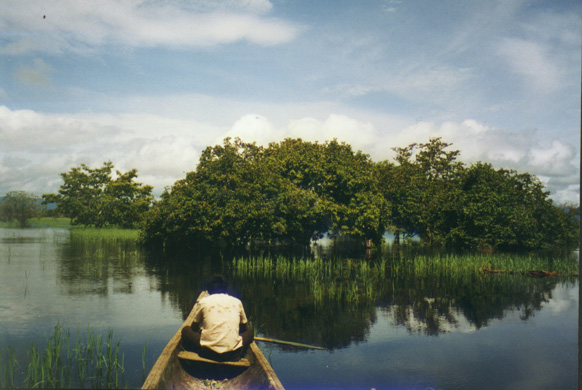
Trees of Campsiandra sp. grow abundantly along the flooded
savanna in the area of San Juan de Manapiare.
Photo by Patricia Luckeroth '98
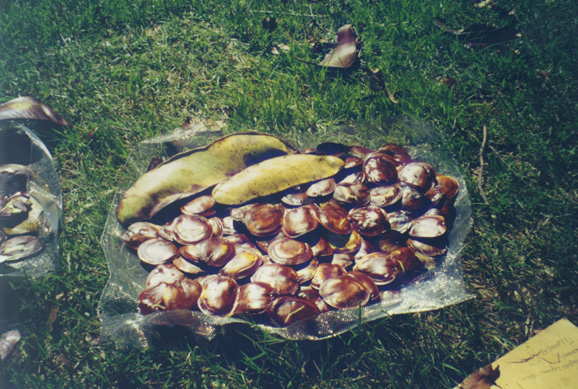
The seeds of Campsiandra sp. can be ground into a fine powder
which can be used to make a type of bread.
Photo by Patricia Luckeroth
return to Emanations vol.1: no.1 contents page